
The Hidden Value of a Forwarded Response: Turning Sales Outreach Into a Warm Internal Introduction
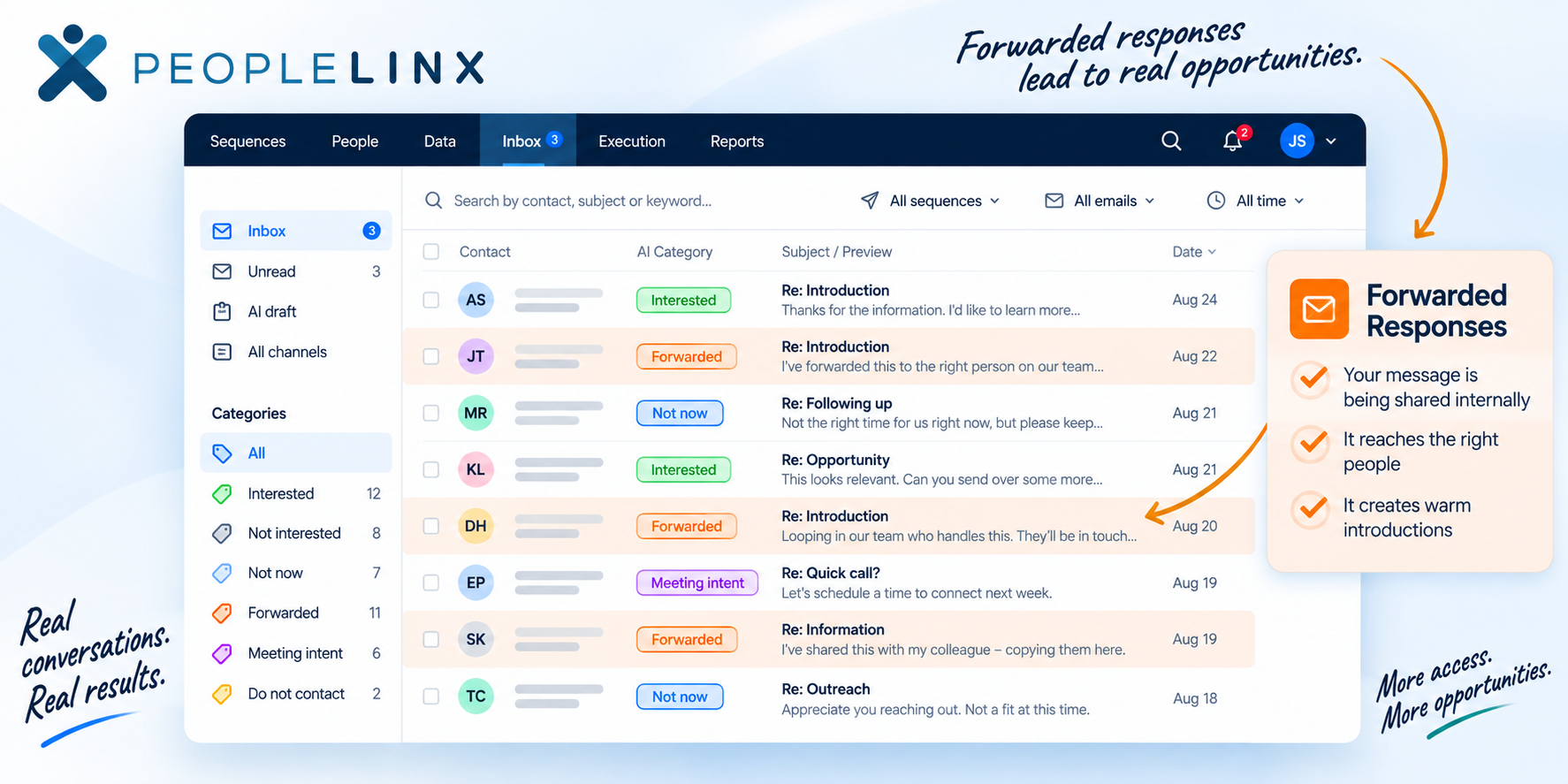
When you're conducting high-quality sales outreach at scale, not every valuable response says, “Yes, let's schedule a meeting.”
Some prospects are interested. Some aren't ready yet. Some ask for more information. Others tell you that someone else inside their organization is the right person to speak with.
At PeopleLinx, we pay particularly close attention to that last category.
Our AI-powered inbox identifies these messages as Forwarded Responses — and they can be among the most valuable responses generated by your sales outreach.
Why?
Because a forwarded response can transform your outreach from a cold external message into a warm internal introduction.
What Is a Forwarded Response?
A Forwarded Response isn't simply an indication that someone may have forwarded your email.
It is an actual response from the prospect telling you that your message has been forwarded, shared or redirected to the person or team responsible for what you're offering.
You might receive a response like:
“Thanks for reaching out. I've forwarded this to our events team, who handles catering.”
Or:
“I'm copying Sarah, who oversees this for our organization.”
Or:
“This isn't my area, but I've passed your information along to the appropriate person.”
In many cases, the prospect will also CC the person responsible directly on the response, immediately creating an introduction and an opportunity to continue the conversation.
That distinction matters enormously.
Your Cold Outreach Just Became an Internal Referral
Think about what has happened.
Your PeopleLinx outreach began with a target organization that your team had already identified as a company you wanted to do business with.
The outreach was then directed toward a relevant decision-maker or influential person within that organization.
That person read your message.
They understood what you were offering.
And rather than simply ignoring it, they made the decision to send it internally to someone they believe should see it.
Your message is no longer arriving solely from an outside salesperson.
It is now arriving with the implicit endorsement of someone inside the organization.
That's an entirely different type of engagement.
Imagine an executive receiving an unsolicited message about a catering program, professional service, software solution or other offering.
Now compare that with an employee receiving essentially the same opportunity from their boss or another senior colleague with a note that says:
“You should take a look at this.”
Those interactions aren't equivalent.
The second carries internal context, relevance and credibility that would be extremely difficult for an outside salesperson to manufacture.
That's why PeopleLinx clients should treat forwarded responses as opportunities — not administrative replies.
The Forward Also Solves One of Sales' Hardest Problems
One of the biggest challenges in outbound sales is determining who actually owns the problem you're trying to solve.
Titles don't always tell you.
Organizational charts don't always tell you.
LinkedIn doesn't always tell you.
But someone working inside the company usually knows.
That's what makes a forwarded response so powerful.
When a senior decision-maker forwards your message to another person, they're effectively telling you:
“This is the person who handles this.”
You have just received information that can be more valuable than another round of prospect research.
You've discovered a relevant stakeholder through an internal organizational referral.
And now you need to act on it.
What Should You Do With a Forwarded Response?
1. Respond Quickly
If the appropriate person has been CC'd, don't wait several days to engage.
Thank the original contact and acknowledge the person they introduced.
Keep the response short, human and contextual. The goal isn't to immediately restart your entire sales pitch. The internal introduction has already created momentum.
Use it.
For example:
“Thanks so much, John — really appreciate you connecting us. Sarah, great to meet you. I'd be happy to send over a little more information and see whether this could be helpful for your team.”
The conversation should feel like what it now is: an introduction.
2. If They Didn't Include the Contact, Ask for the Introduction
Sometimes a prospect will tell you they forwarded your message without including the recipient.
Don't assume the opportunity ends there.
Thank them and ask whether they'd be comfortable connecting you directly.
Give them a reason.
For example:
“Thank you — I really appreciate you passing this along. If you wouldn't mind looping us together or sharing their contact information, I'd love to send them a few examples specifically relevant to your organization.”
This can be especially worthwhile for a high-value strategic account.
The person has already demonstrated willingness to help by forwarding your message. Asking politely for the introduction is a natural next step.
3. Research the New Stakeholder
Once you know who owns the responsibility, learn about them.
Look at their role, responsibilities and background. Connect with them on LinkedIn where appropriate.
The forwarded response may also teach you something important about how the organization makes decisions.
The executive who received your initial outreach may be an influencer.
The person receiving the forward may be an operational owner.
Another stakeholder may ultimately control budget.
You're beginning to build an account map, not simply chase an email response.
4. Add the Relationship to Your CRM
Don't allow a valuable internal referral to disappear inside someone's inbox.
Document:
The original contact
The person receiving the forward
The relationship between them
The reason for the referral
The date of the interaction
The appropriate next step
Any follow-up date
A response that doesn't produce a meeting today may still become a significant opportunity weeks or months later.
5. Follow Up Differently Than You Would With a Cold Prospect
Once an internal referral has occurred, your follow-up should acknowledge it.
Instead of:
“Just following up on my previous email…”
you now have context:
“John had passed our information along to you regarding your catering needs, so I wanted to circle back…”
That's a dramatically stronger reason to be in someone's inbox.
You've earned context.
Don't throw that context away by treating the person like another cold prospect.
6. Use Multiple Channels Thoughtfully
Email doesn't need to be the only next step.
Depending on the opportunity, you might:
Connect with the new stakeholder on LinkedIn
Follow their company or relevant initiatives
Add the account and contacts to your CRM
Schedule an appropriate follow-up
Send a useful case study or resource
Identify additional stakeholders within the account
Personalize future outreach around the original referral
The goal isn't to bombard the prospect across channels.
It's to make sure a meaningful opportunity doesn't get lost.
The Compounding Value of Forwarded Responses
One forwarded response might not seem transformational.
But PeopleLinx isn't designed around sending a handful of random emails.
It's designed to orchestrate high-quality sales activity across carefully selected target accounts at scale.
That changes the math.
A sales organization might generate several forwarded responses in a week, dozens in a month and hundreds over time.
Each represents another internal pathway into an organization the company has already identified as valuable.
Over time, those interactions create something bigger than an email campaign.
They create a growing network of:
Target accounts → senior contacts → internal referrals → correct stakeholders → relationships → opportunities.
That's a valuable sales asset.
Don't Measure Outreach Only by Meetings Booked
Meetings and qualified leads matter.
But evaluating outbound sales exclusively by immediately booked meetings misses much of the value created by good sales orchestration.
A high-quality outreach program generates signals.
Interested replies are signals.
“Not now” responses are signals.
Requests for information are signals.
Internal referrals are especially strong signals.
A forwarded response tells you that someone important enough to receive your outreach found the message relevant enough to take action inside their own organization.
Your company has gained awareness.
Your website may gain new visitors.
Your offering is being discussed internally.
You've identified another stakeholder.
And your message may now carry the credibility of an internal source.
That deserves attention.
PeopleLinx Helps You Identify the Opportunity — Your Team Turns It Into a Relationship
PeopleLinx's AI-powered inbox helps identify and categorize responses, including Forwarded Responses, so important opportunities don't disappear among the many interactions generated by your outreach.
PeopleLinx sales pipeline reporting can also help surface these opportunities and identify potential next steps.
But technology is only part of the equation.
The greatest value comes when salespeople recognize what these signals mean and take the appropriate human action.
Respond. Connect. Research. Document. Follow up. Build the relationship.
And remember: the objective of great sales outreach isn't simply to get an email response.
It's to create a path into the right organizations, with the right people, at the right time.
Sometimes the person you initially contact isn't the person who ultimately buys from you.
Sometimes their greatest value is opening the door to the person who will.
If you're unsure how to handle a Forwarded Response or want help developing the right follow-up strategy for a strategic account, contact your PeopleLinx account manager. Clients can also take advantage of resources available through our Sandler sales training partnership to strengthen follow-up, qualification and opportunity development.
I deliberately made the “cold outreach → internal referral” concept the centerpiece because I think that's the strongest insight here. It also gives your team something bigger to teach clients than simply “make sure you follow up with forwards.”
