First-Party vs. Third-Party Intent Data: Why the Future of Sales Starts Inside Your Pipeline
Patrick Baynes, CEO · Nov 18, 2026
Stop guessing who’s ready to buy. Start understanding who’s already showing you.
For years, B2B sales teams have invested millions of dollars trying to answer one question:
Who’s in the market for what we’re selling?
The traditional answer has been third-party intent data: purchasing information about companies researching certain topics, visiting industry websites, consuming content, or demonstrating behaviors that suggest they might be interested in a product or service.
It’s an approach that helped define the modern outbound sales industry.
But there’s a problem.
While sales teams are spending money trying to predict the intentions of strangers, they’re often overlooking the buying signals coming directly from their own prospects and customers.
At PeopleLinx, we believe the next evolution of sales intelligence isn’t about buying more data.
It’s about turning the relationships, conversations, and engagement already happening across your sales pipeline into actionable revenue intelligence.
And that’s where first-party intent data changes everything.
First-Party vs. Third-Party Intent Data: What’s the Difference?
Both types of intent data can help businesses identify potential buying opportunities. But they tell very different stories.
Third-Party Intent Data: Who Might Be Interested?
Third-party intent data is collected outside your company’s direct interactions with prospects and customers.
It often includes signals such as:
- Companies researching relevant topics across external websites
- Content consumption related to your industry
- Searches or activity associated with specific products or solutions
- Account-level interest trends collected by outside data providers
These signals can be useful for identifying new markets, prioritizing prospecting, and discovering potential buyers.
But they’re generally indirect.
Just because someone at a company is researching sales automation doesn’t mean that company is ready to purchase your solution.
It doesn’t tell you who the decision-maker is, what their budget looks like, or whether they’re already evaluating a competitor.
And it certainly doesn’t tell your sales representative what to do next.
Third-party intent data tells you where interest might exist. It doesn’t necessarily tell you where a relationship stands.
First-Party Intent Data: What Are Your Prospects Actually Telling You?
First-party intent data comes directly from interactions between your business and the people you’re trying to reach.
Think about everything that happens throughout a sales relationship:
- A prospect responds to an email or requests more information.
- A decision-maker attends a meeting or asks for pricing.
- A customer discusses expanding into additional locations.
- A previously unresponsive prospect reengages after several months.
- A franchise operator expresses interest in launching a new initiative.
- A customer indicates that a contract renewal or purchasing decision is approaching.
These aren’t simply indicators that someone might be interested.
They’re direct evidence of engagement, timing, needs, and potential opportunities.
When properly captured, organized, and interpreted, these interactions can provide a far more actionable picture of your sales pipeline.
The Real Problem: Most Companies Already Have the Data. They Just Can’t Use It.
Consider a company with 5,000 prospects and customers in its CRM.
Some have never responded.
Others have opened conversations but haven’t committed.
Hundreds have expressed interest in specific products or services.
Some may be ready to buy today.
And existing customers may represent significant expansion opportunities.
But ask the sales leader a few basic questions:
Which 100 accounts should we focus on this week?
Which prospects are showing the strongest buying intent?
Which relationships have the greatest long-term revenue potential?
Which opportunities are stalled, and what should happen next?
In many organizations, getting those answers requires manually reviewing CRM records, interpreting scattered notes, and asking sales representatives for updates.
The data exists.
The intelligence doesn’t.
That’s the problem PeopleLinx is helping solve.
Introducing a New Approach: Live Pipeline Intelligence From PeopleLinx
PeopleLinx helps sales organizations move beyond static contact lists, disconnected outreach activity, and traditional pipeline reporting.
By combining structured outreach, direct prospect engagement, sales activity, and ongoing performance analysis, PeopleLinx helps teams build a clearer, continuously updated understanding of their pipeline.
Instead of simply reporting how many emails were sent or how many meetings were booked, the objective is to answer more valuable questions:
Who is interested? How interested are they? What could the relationship be worth? And what should we do next?
This approach creates three powerful capabilities.
1. Understand the Intent Level of Your Entire Pipeline
Not every prospect deserves the same attention.
A contact who has never responded shouldn’t be treated the same way as a decision-maker who has requested a proposal.
PeopleLinx helps teams organize pipeline engagement into meaningful intent levels, such as:
| Intent level | What it means | Recommended action |
|---|---|---|
| High intent | Active buying conversations, requests for pricing, or clear purchase timelines | Prioritize personal follow-up and move toward a decision |
| Medium intent | Meaningful engagement, demonstrated interest, or early-stage discussions | Continue targeted conversations and uncover buying requirements |
| Low intent | Limited engagement or early awareness | Maintain relevant, lower-frequency outreach |
| No confirmed intent | No meaningful direct buying signal yet | Validate fit and establish an initial relationship |
| Expansion opportunity | Existing relationship with indicators of additional revenue potential | Develop a targeted account growth plan |
Rather than relying exclusively on assumptions about what an account might be researching, sales teams can prioritize based on actual interactions and demonstrated interest.
And because engagement changes, these classifications should evolve as new information becomes available.
2. See the Revenue Potential, Not Just the Contact Count
Traditional sales reports often focus on the number of leads, opportunities, and deals in the pipeline.
But a pipeline containing 1,000 prospects doesn’t necessarily represent more value than one containing 100 highly qualified relationships.
What matters is the potential economic value of those relationships.
PeopleLinx’s approach incorporates estimated customer lifetime value, or LTV, alongside engagement and intent.
For example, a franchise brand working with hundreds of independently operated locations might have several very different opportunities:
A single restaurant operator could represent an initial sale.
A multi-unit franchisee could represent recurring revenue across 20 locations.
A regional operating group could create an opportunity across an entire market.
Understanding the estimated lifetime value of each relationship helps sales teams prioritize beyond the immediate transaction.
The goal isn’t simply to close more deals. It’s to identify, develop, and retain the relationships with the greatest long-term revenue potential.
LTV estimates can be modeled using factors such as expected contract value, customer duration, number of locations, and expansion potential, with assumptions made transparent.
3. Turn Pipeline Intelligence Into Specific Next Steps
This is where the real transformation happens.
Knowing that a prospect is interested is useful.
Knowing exactly what to do about it is far more valuable.
PeopleLinx helps sales teams translate pipeline engagement into recommended actions.
For example:
A high-intent prospect has requested pricing but hasn’t received a follow-up in four days.
Next step: Schedule a direct conversation, address outstanding questions, and confirm the buying timeline.
A medium-intent franchise operator has expressed interest but needs approval from other stakeholders.
Next step: Identify the decision-making group and provide a relevant business case.
An existing customer has demonstrated interest in expanding to additional locations.
Next step: Build an expansion proposal based on account potential and existing results.
A previously inactive prospect has reengaged after several months.
Next step: Reconnect personally, reference the prior conversation, and reassess timing.
The difference is fundamental.
Instead of giving sales representatives another dashboard to interpret, we’re helping provide a prioritized plan of action.
What a Live Pipeline Report Can Look Like
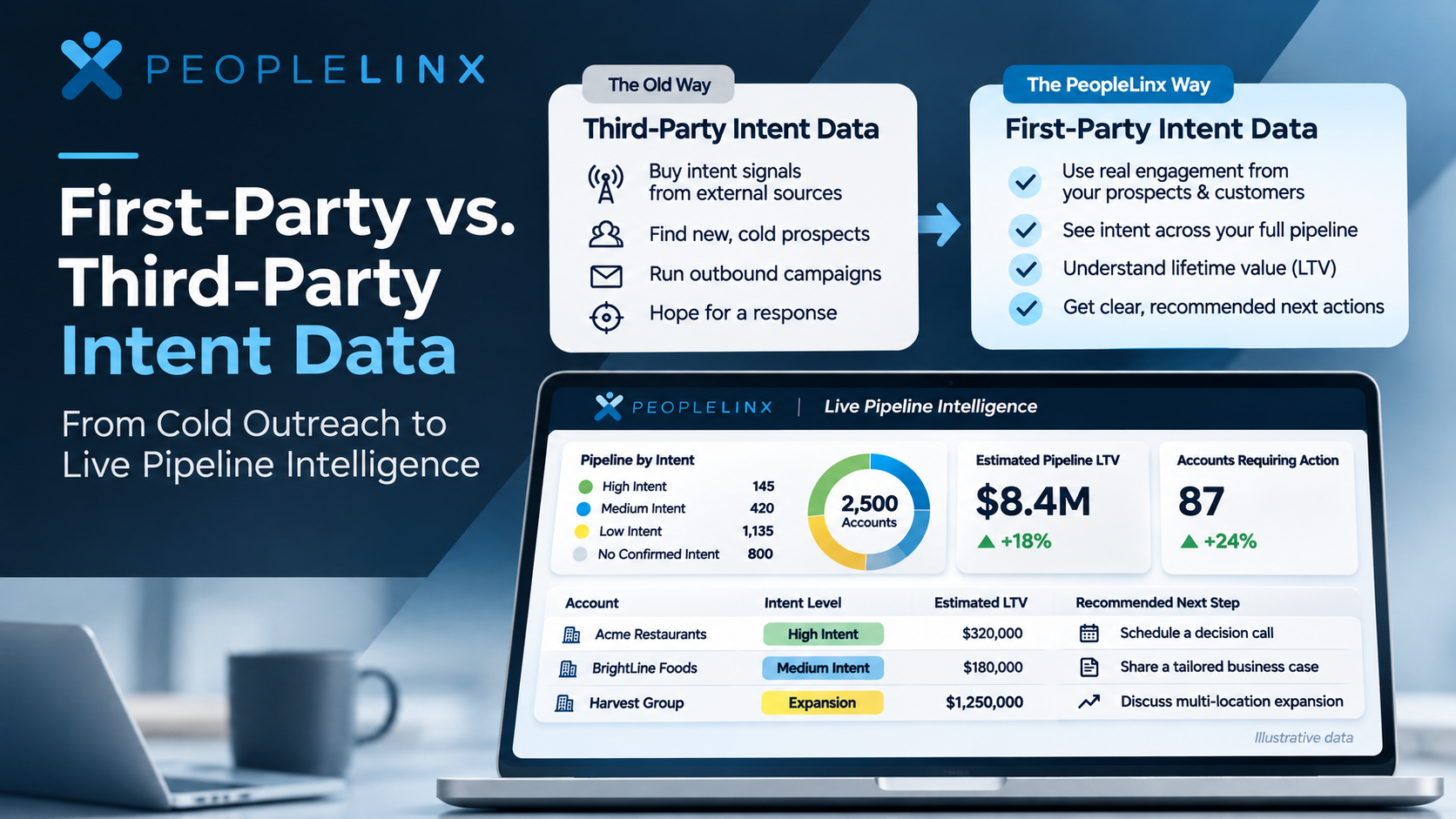
Imagine opening your sales dashboard on Monday morning and seeing something like this:
Illustrative example — not actual PeopleLinx customer data.
| Pipeline intelligence | Example |
|---|---|
| Total accounts monitored | 2,500 |
| High-intent accounts | 145 |
| Medium-intent accounts | 420 |
| Low/no-confirmed-intent accounts | 1,935 |
| Estimated total pipeline LTV | $8.4M |
| Estimated high-intent account LTV | $2.1M |
| Accounts requiring immediate action | 87 |
Now imagine that instead of stopping at those numbers, your team can drill into the individual accounts, understand why they’ve been classified a certain way, see their estimated value, and receive a recommended next action.
That’s the difference between activity reporting and actionable pipeline intelligence.
And that’s the direction we’re taking sales orchestration at PeopleLinx.
Why This Changes the Economics of Sales
Third-party intent data often feeds a traditional outbound model:
Buy data. Identify potential buyers. Launch campaigns. Generate responses. Qualify opportunities. Repeat.
That model can still play an important role in prospect discovery.
But it can also encourage sales organizations to continually purchase more contacts while underutilizing the relationships they’ve already established.
A first-party intelligence strategy creates a different operating model:
Build relationships. Capture engagement. Understand intent. Prioritize value. Take action. Learn and optimize.
The potential advantages are significant.
Sales teams can spend less time pursuing low-probability opportunities and more time developing meaningful conversations.
Managers can gain better visibility into pipeline health without relying entirely on subjective updates.
Leadership can evaluate the revenue potential of the broader customer and prospect base rather than focusing only on near-term deals.
And customer-facing teams can uncover expansion and retention opportunities that might otherwise remain hidden.
Importantly, first-party intent doesn’t eliminate the need for third-party data. External signals can still help identify promising new accounts.
But the most valuable intelligence often emerges once a relationship begins.
From Cold Outreach to Revenue Orchestration
At PeopleLinx, we’ve always believed that better sales outcomes come from more authentic, relevant, and timely engagement.
That belief is becoming even more important as AI makes it easier than ever to generate and distribute massive volumes of automated outreach.
Sending more messages isn’t necessarily a competitive advantage anymore.
Knowing who to contact, why to contact them, and what to say next is.
That’s why we’re focused on helping sales organizations connect prospect data, outreach, engagement, and pipeline intelligence into a more effective revenue orchestration strategy.
Third-party intent can help you find the next prospect.
First-party intent can help you understand the relationship you’ve already started.
And when that intelligence is combined with estimated lifetime value and specific next steps, sales organizations can make better decisions about where to invest their time and resources.
The Future of Sales Isn’t More Data. It’s Better Decisions.
The next generation of high-performing sales teams won’t necessarily be the teams with the largest contact databases or the most automated outbound campaigns.
They’ll be the teams that understand their pipelines most clearly.
They’ll know which relationships are gaining momentum, which opportunities deserve attention, where long-term value exists, and what actions are most likely to move business forward.
At PeopleLinx, we’re helping make that future a reality.
Less guessing. More understanding. Better conversations. More revenue.
Turn Your Pipeline Into Actionable Revenue Intelligence
Your sales pipeline is more than a collection of names, contact records, and open opportunities.
It’s a network of relationships, buying signals, and potential revenue waiting to be better understood.
PeopleLinx helps organizations turn that information into actionable sales intelligence, connecting intent, lifetime value, and next steps to drive smarter outreach and stronger revenue outcomes.
Discover a better way to understand and activate your pipeline.
Visit PeopleLinx to learn more.