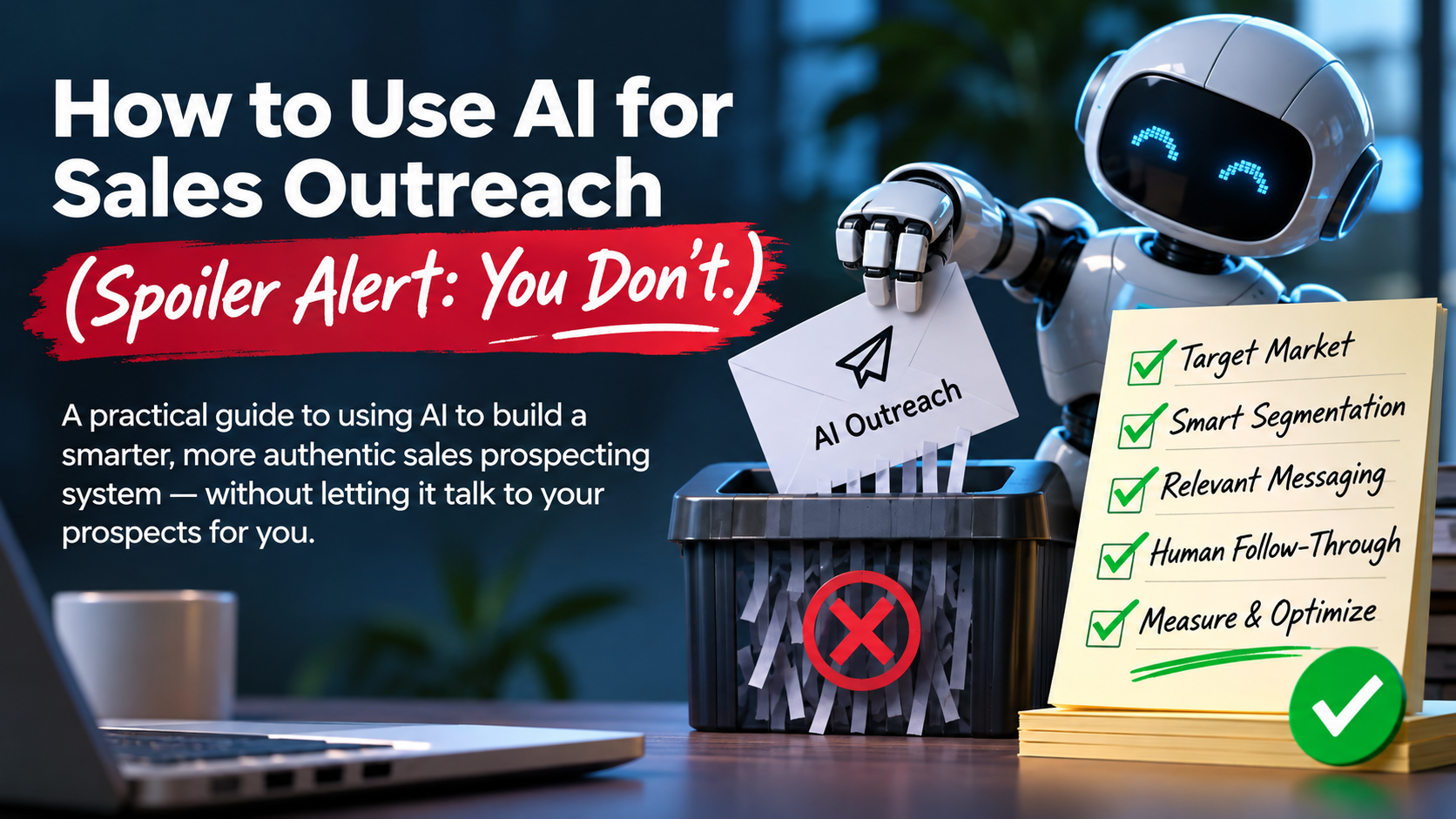
How to Use AI for Sales Outreach (Spoiler Alert: You Don't.)
Patrick Baynes, CEO · Nov 24, 2026
The secret to scalable sales prospecting isn't more artificial intelligence. It's more intentional human intelligence.
Everyone is looking for the perfect AI sales agent. One that can identify prospects, write personalized emails, initiate conversations, handle objections, and book meetings while you sleep.
It sounds great in theory.
In practice, we're seeing an unprecedented amount of low-quality outreach, manufactured personalization, and companies actively damaging their reputations in the name of efficiency.
We've become so obsessed with automating sales prospecting that we've forgotten what makes sales prospecting effective in the first place.
Relevance. Credibility. Timing. Authenticity.
AI absolutely has a place in modern sales organizations. But knowing where not to use it is becoming just as important as knowing where to use it.
1. Start With Strategy, Not Technology
Before you purchase another AI sales tool or deploy an autonomous sales agent, take a step back.
Who is your target market?
It's a fundamental business exercise, yet it's one that far too many organizations rush through.
You need to understand:
- Which industries represent your strongest opportunities?
- Which geographic markets should you prioritize?
- What types of organizations are most likely to benefit from your solution?
- Who are the decision-makers within those organizations?
- What meaningful connections can you establish with them?
- Where do you have existing credibility, relationships, or relevant customer success stories?
Just because your total addressable market consists of 100,000 potential customers doesn't mean you should attempt to reach all 100,000 of them at once.
That's not a strategy. That's a distribution list.
Categorize your market. Prioritize your opportunities. Identify logical segments where you can establish meaningful connections and communicate a compelling, relevant value proposition.
Approach it exactly as an exceptional salesperson would if they were prospecting one person at a time.
Then build a system around that approach.
2. Build Smaller, Smarter Prospect Databases
Once you've identified a meaningful market segment, build a high-quality database of prospects within it.
Start with 1,000 or 2,000 contacts, not 15,000 or 20,000.
The larger numbers can come later, once you've established a repeatable model that actually works.
Your initial database should represent a thoughtfully selected group of individuals who share enough common characteristics that you can speak to them with genuine relevance.
Perhaps they're franchise owners in a particular region, business leaders experiencing similar growth challenges, or sales executives within an industry where you've already demonstrated success.
This is an excellent opportunity to leverage AI.
Use it to research companies, identify decision-makers, uncover market signals, enrich contact records, and discover meaningful connections between your business and your prospective customers.
AI can dramatically accelerate the work required to build an intelligent prospect database.
But building the database and communicating with the people in it are two very different disciplines.
3. Write to One Person, Even When You're Reaching Thousands
Imagine you're sitting down to write an email to one specific prospective customer.
Not a thousand people. Just one.
What would you say?
What would make that person care? What credibility could you establish? What existing customers could you reference? What challenges are they likely experiencing right now?
Consider where they're located, what time of year it is, what's happening in their industry, and even which day of the week they're receiving your message.
If you're reaching restaurant operators, for example, their priorities in the weeks leading up to the holidays may be dramatically different from their priorities in January.
If you're reaching franchise owners in a specific geographic market, referencing your experience with other operators in that region can establish immediate credibility.
These details matter.
The strongest outreach doesn't simply personalize a first name, company name, or job title. It demonstrates an understanding of the recipient's world.
And that requires thoughtful human involvement.
Write the strongest possible message to one person, then thoughtfully scale that message to a group of people for whom it is equally relevant.
That's authentic outreach at scale.
4. Every Touchpoint Deserves Human Thought
A sales sequence isn't just an introductory email followed by a series of automated reminders.
It's an opportunity to gradually establish familiarity, demonstrate credibility, provide value, and earn a conversation.
Every touchpoint should have a purpose.
Your second email shouldn't simply ask whether someone saw your first email. Your third email shouldn't be another variation of the same pitch.
Introduce something new. Share a relevant customer example. Provide an interesting industry observation. Establish another meaningful connection. Give the recipient a legitimate reason to engage.
And above all, don't let your outreach smell like marketing.
People know what a mass-produced email looks like. Increasingly, they also know what an AI-generated email looks like.
The manufactured compliments. The generic observations. The forced personalization. The unnatural enthusiasm. The endless follow-ups from someone who has clearly never thought about their business.
That's the AI slop flooding our inboxes today.
Your company's reputation is attached to every one of those messages.
Treat it accordingly.
5. Automation Is Not the Enemy
There's an important distinction between automating the delivery of thoughtful human communication and automating the communication itself.
We absolutely believe in outreach automation.
A well-designed sales prospecting system should automate scheduling, sequencing, delivery, engagement tracking, data management, and other repetitive administrative tasks.
That's how you create leverage.
There may even be a place for more autonomous AI-driven communication when nurturing large databases of historical prospects, dormant leads, or existing relationships that your team otherwise lacks the resources to engage.
Even then, thoughtfully constructed, human-led sequences are preferable.
When it comes to introducing your company to a new prospective customer, however, you're making a first impression.
That's not something you should casually outsource to an autonomous AI agent.
Automate the mechanics. Own the message.
6. Put a Real Salesperson Behind the System
A scalable outreach system should operate in parallel with an engaged internal sales resource.
Too many organizations treat automated prospecting as an isolated lead generation function, expecting meetings to magically appear on their calendars.
But there's an enormous amount of value between the initial outreach and the booked meeting.
Who is engaging with your messages?
Who is responding with questions?
Who is demonstrating buying intent but hasn't explicitly requested a conversation?
Which accounts are showing increased interest over time?
These are opportunities for intelligent, targeted human follow-through.
Your sales team should have visibility into prospect engagement, lead scores, account activity, and recommended next steps.
Tools like the free PeopleLinx Lead Scoring app, available in the app stores, can help sales professionals incorporate more structured lead prioritization into their daily activities.
The objective is to give your salespeople better information, better opportunities, and more time to do what they do best: build relationships and close business.
Technology should make your salespeople more effective, not make them irrelevant.
7. Measure Everything and Scale What Works
Once you've established a thoughtfully designed prospecting system, you can begin measuring and optimizing it.
Track performance across:
- Target industries and market segments
- Geographic regions
- Buyer personas
- Email deliverability and open rates
- Response rates and positive response rates
- Lead volume and lead quality
- Qualified meetings
- Pipeline generated
- Customer acquisition and lifetime value
Don't confuse activity with performance. Open rates can be distorted by privacy features and automated activity. Responses aren't necessarily qualified opportunities. Meetings aren't necessarily revenue.
The real advantage of this approach is that you can identify precisely which combinations of audiences, messaging, timing, and value propositions are generating meaningful business outcomes.
Then you can expand into additional markets, increase your prospect database, refine your messaging, and build upon what's already working.
That's when you scale from 2,000 prospects to 20,000.
Not before.
So, Where Should You Actually Use AI in Sales?
AI can be extraordinarily valuable throughout the sales prospecting lifecycle.
| Use AI to accelerate | Keep humans accountable for |
|---|---|
| Go-to-market research | Go-to-market decisions |
| Market segmentation | Target prioritization |
| Target account identification | Relationship strategy |
| Industry news and buying signals | Interpreting relevance |
| Prospect data enrichment | Messaging and positioning |
| Database development | Outreach copy and tone |
| Engagement analysis | Meaningful follow-through |
| Lead scoring and prioritization | Sales conversations |
| Pipeline reporting | Relationship development |
| Performance analysis | Strategic optimization |
AI can help you understand your market better, build stronger databases, identify opportunities faster, and make more informed decisions.
It can help you become a significantly more intelligent sales organization.
But it shouldn't be given unchecked responsibility for how your company introduces itself to the world.
Don't Scale to Fail
One of the greatest risks with AI-powered sales outreach is that it allows companies to scale bad decisions faster than ever before.
Bad targeting at scale.
Bad messaging at scale.
Bad first impressions at scale.
You can now alienate 20,000 prospective customers in the time it previously took to alienate 200.
That's not innovation. That's scaling to fail.
At PeopleLinx, we believe the future of sales prospecting isn't about replacing authentic human communication with artificial intelligence.
It's about combining intelligent strategy, high-quality prospect data, thoughtful human messaging, outreach automation, and actionable engagement intelligence into one scalable system.
Use AI to do the research.
Use AI to build the intelligence.
Use automation to create the scale.
Use people to create the connection.
Because the goal isn't to reach more people. It's to mean more to the people you reach.
PeopleLinx helps organizations build scalable, authentic sales prospecting systems through strategic planning, prospect data, outreach automation, and performance optimization.
Build a smarter approach to sales prospecting at PeopleLinx.com.